AI Systems: Self-Hosted Assistants, RAG, and Local Infrastructure
Most local AI setups start with a model and a runtime.
You download a quantized model, launch it through Ollama or another runtime, and begin prompting. For experimentation, this is more than enough. But once you move beyond curiosity — once you care about memory, retrieval quality, routing decisions, or cost awareness — the simplicity starts to show its limits.
This cluster explores a different approach: treating the AI assistant not as a single model invocation, but as a coordinated system.
That distinction may seem subtle at first, but it changes how you think about local AI entirely.
What Is an AI System?
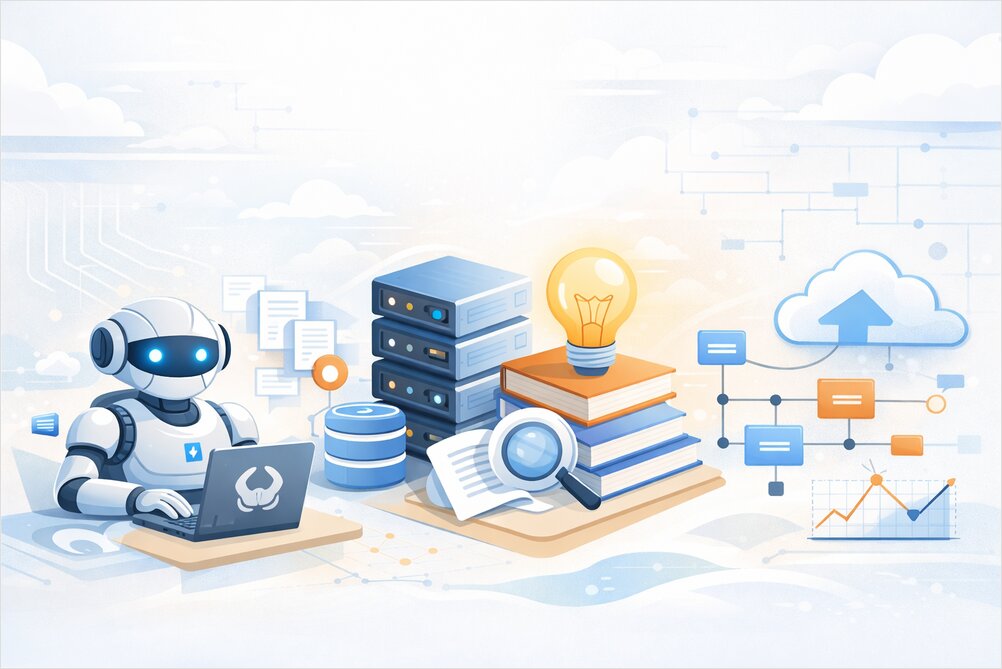
An AI system is more than a model. It is an orchestration layer connecting inference, retrieval, memory, and execution into something that behaves like a coherent assistant.
Running a model locally is infrastructure work. Designing an assistant around that model is systems work.
If you have explored our broader guides on:
- LLM Hosting in 2026: Local, Self-Hosted & Cloud Infrastructure Compared
- LLM Architecture: System Design for Production AI — routing, cost optimization, guardrails, and multi-model orchestration
- Retrieval-Augmented Generation (RAG) Tutorial: Architecture, Implementation, and Production Guide
- Second brain explained for engineers and knowledge workers
- LLM Performance in 2026: Benchmarks, Bottlenecks & Optimization
- Observability for AI Systems
you already know that inference is only one layer of the stack.
The AI Systems cluster sits on top of those layers. It does not replace them — it combines them.
For a cross-cutting map of how those layers fit together in production assistants — LLM, memory, tooling, routing, and observability, with OpenClaw and Hermes as reference systems — see AI Assistant Architecture: LLM, Memory, Tools, Routing, Observability.
Once the assistant architecture is solid, the next step is making it proactive. Polling Agents in AI Assistants: 11 Implementation Patterns covers how background polling workers, queue-based execution, durable workflows, and semantic LLM evaluators turn a reactive assistant into one that watches, decides, and acts on its own.
When a single assistant is not enough and multiple agents need to coordinate, the choice of coordination pattern determines everything: latency, fault tolerance, cost, and debuggability. Multi-Agent Orchestration Patterns: A Practical Guide covers the six canonical patterns — orchestrator-worker, sequential pipeline, fan-out, hierarchical, swarm, and mesh — with specific failure modes and a decision framework for picking the right architecture.
OpenClaw: A Self-Hosted AI Assistant System
OpenClaw is an open-source, self-hosted AI assistant designed to operate across messaging platforms while running on local infrastructure.
At a practical level, it:
- Uses local LLM runtimes such as Ollama or vLLM
- Integrates retrieval over indexed documents
- Maintains memory beyond a single session
- Executes tools and automation tasks
- Can be instrumented and observed
- Operates within hardware constraints
It is not just a wrapper around a model. It is an orchestration layer connecting inference, retrieval, memory, and execution into something that behaves like a coherent assistant.
Getting started and architecture:
- OpenClaw quickstart guide — Docker-based installation using either a local Ollama model or a cloud-based Claude configuration
- OpenClaw system overview — architectural exploration of how OpenClaw differs from simpler local setups
- NemoClaw guide for secure OpenClaw operations — security-first OpenClaw path with OpenShell sandboxing, policy tiers, routed inference, and day-two operations
Context and analysis:
- OpenClaw rise and fall timeline — the economics behind the viral spike, the April 2026 subscription cutoff, and what the collapse reveals about AI hype cycles
- OpenClaw vs Hermes Agent — stars, downloads, and usage data — live leaderboard of 20 frameworks with OpenRouter token rankings, package download counts, community health metrics, and search trend analysis
Extending and configuring OpenClaw:
Plugins extend the OpenClaw runtime — adding memory backends, model providers, communication channels, web tools, and observability. Skills extend agent behavior — defining how and when the agent uses those capabilities. Production configuration means combining both, shaped around who is actually using the system.
- OpenClaw Plugins — Ecosystem Guide and Practical Picks — native plugin types, CLI lifecycle, safety rails, and concrete picks for memory, channels, tools, and observability
- OpenClaw Skills Ecosystem and Practical Production Picks — ClawHub discovery, install and removal flows, per-role stacks, and the skills worth keeping in 2026
- OpenClaw Production Setup Patterns with Plugins and Skills — complete plugin and skill configurations by user type: developer, automation, research, support, and growth — each with combined install scripts
Hermes: A Persistent Agent with Skills and Tool Sandboxing
Hermes Agent is a self-hosted, model-agnostic assistant focused on persistent operation: it can run as a long-lived process, execute tools through configurable backends, and improve workflows over time through memory and reusable skills.
At a practical level, Hermes is useful when you want:
- A terminal-first assistant that can also bridge into messaging apps
- Provider flexibility through OpenAI-compatible endpoints and model switching
- Tool execution boundaries via local and sandboxed backends
- Day-two operations with diagnostics, logs, and config hygiene
Hermes profiles are fully isolated environments — each with its own config, secrets, memories, sessions, skills, and state — making profiles the real unit of production ownership, not the individual skill.
- Hermes AI Assistant - Install, Setup, Workflow, and Troubleshooting — installation, provider setup, workflow patterns, and troubleshooting
- Hermes Agent CLI cheat sheet — commands, flags, and slash shortcuts — tabular index of
hermessubcommands, global flags, gateway and profile tooling, and common slash shortcuts - Hermes Agent Headless Server and Remote Desktop Setup — headless deployment topology for remote desktop access over LAN and VPN
- Hermes Voice Control from Your Phone — mobile-first voice workflow for Telegram and Discord, with STT and TTS provider tuning plus troubleshooting
- Hermes Agent Memory System: How Persistent AI Memory Actually Works — deep technical guide to the two-file core memory, frozen snapshot pattern, all 8 external providers, and the philosophy of bounded memory
- Hermes AI Assistant Skills for Real Production Setups — profile-first skill architecture for engineers, researchers, operators, and executive workflows
- Hermes Agent Skill Authoring — SKILL.md Structure and Best Practices — practical
SKILL.mdlayout, metadata, conditional activation, and troubleshooting when skills vanish from the index - Kanban in Hermes Agent for Self Hosted LLM Workflows — practical control patterns for dispatcher concurrency, dependency chains, and cron based batching on self-hosted gateways
- How to Migrate from OpenClaw to Hermes Agent Safely — staged cutover runbook covering
hermes claw migratedry-runs, conflict policy, secret handling, messaging handover, and rollback
Persistent knowledge and memory
Some problems are not solved by a bigger context window alone — they need persistent knowledge (graphs, ingestion pipelines) and agent memory plugins (Honcho, Mem0, Hindsight, and similar backends) wired into assistants such as Hermes or OpenClaw.
- AI Systems Memory hub — scope of the memory subcluster plus links to Cognee guides and stack context
- Memory Systems in AI Assistants That Actually Help — cross-framework memory design for working state, structured facts, and retrieval layers
- Agent memory providers compared — full comparison of Honcho, OpenViking, Mem0, Hindsight, Holographic, RetainDB, ByteRover, and Supermemory for Hermes-style integrations
MCP: Model Context Protocol Servers
The Model Context Protocol (MCP) is an open standard introduced by Anthropic for connecting AI language models to external data sources, tools, and systems. It solves the N×M integration problem by providing a universal interface — think of it as a USB-C port for AI applications. Building MCP servers lets you extend AI assistants with custom integrations for files, databases, APIs, and callable tools, using a simple JSON-RPC based protocol over stdio or HTTP.
- Agent Skills vs MCP Servers: Decision Framework — practical decision framework for when to use skills, when to build MCP servers, and how the thin-server pattern combines both
- MCP Server in Go — protocol architecture, JSON-RPC message structure, capability negotiation, official Go SDK, and a step-by-step tutorial for building MCP servers in Go
- Building MCP Servers in Python — practical Python implementation guide covering web search and scraping MCP servers, stdio and SSE transports, and Claude Desktop integration
A2A: Agent-to-Agent Protocol
The Agent2Agent Protocol (A2A) is an open standard for communication between independently deployed AI agent systems. Where MCP connects an agent to tools, A2A connects agents to other agents — letting them discover each other via Agent Cards, exchange tasks and messages, stream progress, and return typed artifacts. A2A is designed for systems where agents are owned by different teams, built with different frameworks, or deployed as separate services that need to interoperate.
- What Is the A2A Protocol? Agent Cards and Tasks Explained — deep-dive into A2A concepts: Agent Cards, task lifecycle, messages, parts, artifacts, streaming, security, and the orchestrator-plus-specialists pattern
- A2A Streaming and Async Tasks for Long-Running Agent Workflows — operational guide to SSE streaming, push webhooks, input_required human-in-the-loop flows, failure handling, and observability for tasks that outlive a single HTTP request
- A2A vs MCP: Do AI Agents Really Need Both Protocols? — practical comparison of the two protocols: when MCP alone is enough, when A2A adds real value, and how the “A2A outside, MCP inside” pattern works at scale
- Google A2A Protocol in 2026: Adoption, Hype, and Reality — a measured look at where A2A actually has production traction in 2026, what the hype gets wrong, and a practical decision framework for when to use it
What Makes AI Systems Different
Several characteristics make AI systems worth examining more closely.
Model Routing as a Design Choice
Most local setups default to one model. AI systems support selecting models intentionally.
That introduces questions:
- Should small requests use smaller models?
- When does reasoning justify a larger context window?
- What is the cost difference per 1,000 tokens?
These questions connect directly to performance trade-offs discussed in the LLM performance guide and infrastructure decisions outlined in the LLM hosting guide.
AI systems surface those decisions instead of hiding them.
Retrieval Is Treated as an Evolving Component
AI systems integrate document retrieval, but not as a simplistic “embed and search” step.
They acknowledge:
- Chunk size affects recall and cost
- Hybrid search (BM25 + vector) may outperform pure dense retrieval
- Reranking improves relevance at the cost of latency
- Indexing strategy impacts memory consumption
These themes align with the deeper architectural considerations discussed in the RAG tutorial.
The difference is that AI systems embed retrieval into a living assistant rather than presenting it as an isolated demo.
Memory as Infrastructure
Stateless LLMs forget everything between sessions.
AI systems introduce persistent memory layers. That immediately raises design questions:
- What should be stored long-term?
- When should context be summarized?
- How do you prevent token explosion?
- How do you index memory efficiently?
Those questions intersect directly with data-layer considerations from the data infrastructure guide. For Hermes Agent specifically — bounded two-file memory, prefix caching, external plugins — start with Hermes Agent Memory System and the cross-framework comparison Agent memory providers compared. The AI Systems Memory hub lists related Cognee and knowledge-layer guides.
Memory stops being a feature and becomes a storage problem.
Observability Is Not Optional
Most local AI experiments stop at “it responds.”
AI systems make it possible to observe:
- Token usage
- Latency
- Hardware utilization
- Throughput patterns
This connects naturally with the monitoring principles described in the observability guide.
If AI runs on hardware, it should be measurable like any other workload.
What It Feels Like to Use
From the outside, an AI system may still look like a chat interface.
Under the surface, more happens.
If you ask it to summarize a technical report stored locally:
- It retrieves relevant document segments.
- It selects an appropriate model.
- It generates a response.
- It records token usage and latency.
- It updates persistent memory if necessary.
The visible interaction remains simple. The system behavior is layered.
That layered behavior is what differentiates a system from a demo.
Where AI Systems Fit in the Stack
The AI Systems cluster sits at the intersection of several infrastructure layers:
- LLM Hosting: The runtime layer where models execute (Ollama, vLLM, llama.cpp)
- RAG: The retrieval layer that provides context and grounding
- Performance: The measurement layer that tracks latency and throughput
- Observability: The monitoring layer that provides metrics and cost tracking
- Data Infrastructure: The storage layer that handles memory and indexing
Understanding that distinction is useful. Running it yourself makes the difference clearer.
For a minimal local installation with OpenClaw, see the OpenClaw quickstart guide, which walks through a Docker-based setup using either a local Ollama model or a cloud-based Claude configuration.
If your setup depends on Claude, this policy change for agent tools clarifies why API billing is now required for third-party OpenClaw workflows.
Related Resources
A2A: Agent-to-Agent Protocol:
- What Is the A2A Protocol? Agent Cards and Tasks Explained
- A2A vs MCP: Do AI Agents Really Need Both Protocols?
- Google A2A Protocol in 2026: Adoption, Hype, and Reality
MCP servers:
AI assistant guides:
- AI Assistant Architecture: LLM, Memory, Tools, Routing, Observability
- Multi-Agent Orchestration Patterns: A Practical Guide
- Polling Agents in AI Assistants: 11 Implementation Patterns
- OpenClaw system overview
- OpenClaw rise and fall timeline
- OpenClaw quickstart guide
- OpenClaw Plugins — Ecosystem Guide and Practical Picks
- OpenClaw Skills Ecosystem and Practical Production Picks
- OpenClaw Production Setup Patterns with Plugins and Skills
- Hermes AI Assistant - Install, Setup, Workflow, and Troubleshooting
- Hermes Agent Memory System: How Persistent AI Memory Actually Works
- AI Systems Memory hub
- Agent memory providers compared
- Hermes AI Assistant Skills for Real Production Setups
- Hermes Agent Skill Authoring — SKILL.md Structure and Best Practices
Infrastructure layers:
- LLM Hosting in 2026: Local, Self-Hosted & Cloud Infrastructure Compared
- Retrieval-Augmented Generation (RAG) Tutorial: Architecture, Implementation, and Production Guide
- LLM Performance in 2026: Benchmarks, Bottlenecks & Optimization
- Agentic LLM inference parameters for Qwen and Gemma
- Observability for AI Systems
- Data Infrastructure for AI Systems
