
A2A vs MCP: Do AI Agents Really Need Both Protocols?
MCP gives agents tools. A2A gives agents peers.
AI agent architecture is starting to split into two layers.
One layer is about giving an AI assistant access to tools, data, APIs, files, databases, search systems, calendars, ticketing systems, and other external capabilities — and that is where MCP fits.
The other layer is about getting one AI agent to discover, communicate with, delegate to, and collaborate with another AI agent, possibly built by another team, framework, vendor, or organization — and that is where A2A fits.
The annoying part is that both protocols are often discussed as if they solve the same problem, and they do not. There is overlap at the edges, and that overlap is where most of the confusion comes from. But the clean mental model is simple:
MCP is mostly agent-to-tool and A2A is mostly agent-to-agent.
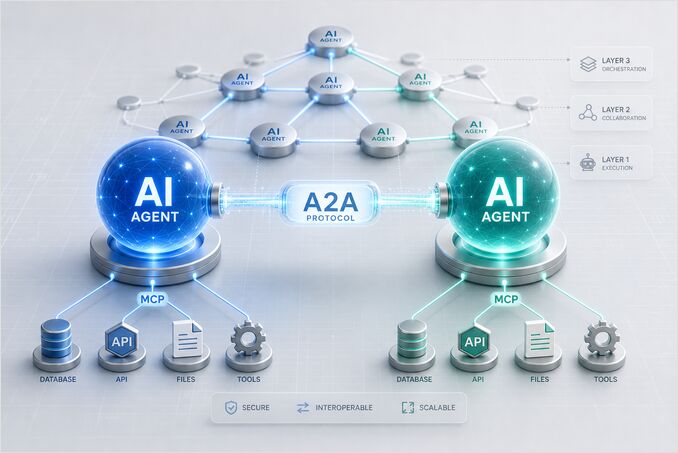
That does not mean every AI system needs both. In fact, most small agent projects should probably start with MCP and ignore A2A until they have a real multi-agent boundary. But if you are building larger agent systems, especially systems with separately deployed agents, specialist agents, vendor agents, or long-running delegated tasks, A2A starts to make sense.
This article explains the difference, the overlap, the architectural tradeoffs, and when you actually need both. If your decision is about whether a capability should be an Agent Skill or an MCP server rather than about agent-to-agent communication, see our Agent Skills vs MCP Servers decision framework.
What Is MCP?
MCP stands for Model Context Protocol.
It is an open protocol for connecting AI applications and agents to external tools, resources, and prompts. In practical terms, MCP lets an AI host such as a desktop assistant, IDE, coding agent, or chat application connect to one or more MCP servers.
An MCP server can expose capabilities such as:
- Tools: callable functions the model can use
- Resources: readable context such as files, API data, documents, or database records
- Prompts: reusable prompt templates or workflows
The official MCP architecture is based on a host, client, and server model.
The MCP host is the application the user interacts with. The MCP client is the protocol component that maintains a connection to a specific MCP server. The MCP server exposes capabilities to the client.
For example, a coding assistant could connect to:
- A filesystem MCP server
- A GitHub MCP server
- A database MCP server
- A Sentry MCP server
- A Slack MCP server
From the user’s point of view, the assistant becomes more useful. From the system architecture point of view, the assistant has gained controlled access to external context and actions.
That is the main value of MCP: it standardizes how an AI application reaches tools and context.
MCP Is Best Understood As Tool Integration
MCP is not only about tools, but tools are the easiest way to understand it.
Without MCP, every AI application needs custom integration code for every external system. One agent framework has its own plugin format. Another has its own tool schema. Another has a different API wrapper pattern. Every integration gets rebuilt again and again.
MCP tries to reduce that waste.
If a tool provider exposes an MCP server, many MCP-compatible clients can use it. If a developer builds an MCP server for an internal system, multiple AI applications can connect to it. Practical implementation guides for MCP servers in Go and MCP servers in Python show how straightforward the integration layer can be once the protocol does the heavy lifting.
That is why MCP has become important so quickly. It solves a boring but painful integration problem.
And boring integration problems are usually where durable standards come from — the ones that survive precisely because they reduce repetitive work that everyone has to do anyway.
What Is A2A?
A2A stands for Agent2Agent Protocol.
It is an open standard for communication and interoperability between independent AI agent systems. For a deeper look at the individual building blocks — Agent Cards, task lifecycle, messages, parts, and artifacts — What Is the A2A Protocol? Agent Cards and Tasks Explained covers each concept in full detail. The official A2A specification describes the protocol as a way for agents built with different frameworks, languages, or vendors to communicate through a common interaction model.
The key phrase is independent agent systems.
A2A is not primarily about giving one assistant access to a calculator, database, or file system. It is about one agent communicating with another agent that has its own capabilities, state, policy, task model, and possibly its own tools behind the scenes.
An A2A agent can advertise what it can do through an Agent Card. Another agent or client can discover that capability, send a task, exchange messages, receive artifacts, and track the task lifecycle.
A2A introduces concepts such as:
- Agent Cards
- Agents and clients
- Tasks
- Messages
- Parts
- Artifacts
- Task states
- Streaming and asynchronous work
Taken together, these concepts make A2A feel more like an agent collaboration protocol than a simple tool invocation protocol — it is designed around the idea that agents have identity, state, and ongoing relationships with other agents.
A2A Is Best Understood As Agent Collaboration
Imagine a user asks an enterprise assistant:
“Prepare a market entry brief for Japan, include legal considerations, pricing risks, and a launch project plan.”
A simple assistant could try to do everything itself. But a larger agent system might delegate pieces of the work:
- A research agent gathers market information
- A legal agent checks regulatory considerations
- A finance agent estimates pricing risk
- A project planning agent produces a delivery plan
- A writing agent assembles the final brief
If those agents are all internal functions inside one codebase, you may not need A2A. You can just call functions or services directly.
But if those agents are independent systems, possibly owned by different teams or vendors, then a standard agent-to-agent protocol becomes useful.
That is the A2A use case.
A2A vs MCP: The Simple Difference
The simplest comparison is this:
| Question | MCP | A2A |
|---|---|---|
| Main relationship | Agent to tool | Agent to agent |
| Main purpose | Connect AI apps to tools, data, and prompts | Let independent agents communicate and collaborate |
| Typical unit of work | Tool call or resource read | Task, message, artifact, delegation |
| Best fit | Tool integration | Multi-agent interoperability |
| Example | Agent calls a database tool | Research agent delegates to legal agent |
| Scope | Context and capability access | Agent coordination and task exchange |
That table is not perfect, but it is useful for building an initial mental model. In short, MCP answers the question “How does this AI application access external capabilities?” while A2A answers “How does this agent work with another agent?”
The distinction matters because tool integration and agent collaboration have different failure modes. A bad tool call might return the wrong data or modify the wrong file, but a bad agent delegation might create an unclear chain of responsibility, leak sensitive context, loop between agents, duplicate work, or produce an artifact nobody can audit. A2A sits one level higher in the architecture, and its failure modes carry correspondingly higher consequences.
Why Developers Confuse A2A and MCP
The confusion is understandable.
Many MCP servers are not just dumb tools. Some MCP servers can perform multi-step work. Some expose high-level capabilities that look agentic. An MCP server could wrap a planning service, a retrieval system, or even another LLM-powered workflow.
At that point, the line gets blurry.
If an MCP tool named research_topic performs a complex research workflow, is it a tool or an agent?
The honest answer is: architecturally, it depends.
If the host treats it as a callable capability with a tool schema, it is functioning as a tool.
If it has its own identity, capabilities, task lifecycle, messages, artifacts, and delegation behavior, it is starting to look like an agent.
This is why “A2A vs MCP” is the wrong framing when it becomes a religious debate. The better framing is:
- Is this external capability best modeled as a tool?
- Or is it best modeled as an independent agent?
That decision should drive the protocol choice.
The Case For MCP Only
Most AI projects should start with MCP only — that is a slightly opinionated position, but a practical one.
If you are building a coding assistant, internal chatbot, local AI workflow, personal automation agent, or simple enterprise assistant, the first problem is usually not agent-to-agent collaboration. The first problem is tool access.
You need the assistant to read files, query databases, search docs, call APIs, open tickets, summarize logs, inspect metrics, or update records.
MCP fits that very well.
Use MCP only when:
- Your agent mainly needs access to tools and data
- You control the host application
- You control most integrations
- The external systems are not really autonomous agents
- The workflow is mostly synchronous or short-running
- A normal tool call is enough
- You do not need agent discovery
- You do not need cross-agent task state
- You do not need artifacts from independent agents
For many systems, MCP plus good application architecture is enough. A lot of teams will over-engineer A2A into systems that are really just tool-using assistants, and that is not a protocol problem — it is an architecture discipline problem that no protocol can fix for you.
The Case For A2A Only
A2A-only systems are less common, but they can exist.
You might use A2A without MCP when the system is mostly about communication between agents, and each agent already manages its own tools internally.
For example:
- A marketplace of specialist agents
- A vendor-to-vendor agent integration
- A cross-organization workflow
- A multi-agent system where each agent has its own private toolchain
- A delegation network where clients should not know internal tool details
In this model, A2A is the public boundary between independently managed agents. Agent A does not need to know whether Agent B uses PostgreSQL, Elasticsearch, MCP, LangChain, custom APIs, or shell scripts behind the scenes. Agent A only needs to know what Agent B can do, how to send it a task, and how to receive results.
That is a clean abstraction.
Use A2A only when:
- You are exposing agents as independent services
- The caller should not know the agent’s internal tools
- Agent capability discovery matters
- Delegation is more important than direct tool access
- Tasks may be long-running
- Results may include artifacts
- Agents may be built by different vendors or teams
A2A is strongest at system boundaries, where independently owned agents need to exchange tasks and artifacts without exposing their internal toolchains. It is not a protocol you need to wire into every layer of every agent runtime.
The Case For Using Both A2A and MCP
The most interesting architecture is not A2A vs MCP. It is A2A plus MCP.
In this pattern, an agent exposes an A2A interface to other agents, but internally uses MCP to access tools.
That gives you two clean layers:
- A2A outside: how agents communicate with each other
- MCP inside: how each agent accesses tools, data, and services
This is probably the most durable mental model.
A customer support agent might expose an A2A interface. Other agents can delegate support-related tasks to it. Internally, the support agent uses MCP servers for Zendesk, Slack, documentation search, CRM lookup, and internal policy retrieval.
A DevOps agent might expose an A2A interface. Other agents can ask it to investigate an incident. Internally, it uses MCP servers for Prometheus, Grafana, GitHub, Kubernetes, logs, and cloud APIs.
A finance agent might expose an A2A interface. Other agents can request budget analysis. Internally, it uses MCP servers for spreadsheets, accounting systems, invoice databases, and forecasting models.
This pattern preserves clean boundaries between agents. Other agents do not need direct access to every tool — they communicate with the specialist agent, which decides internally which tools are needed to complete the task.
That is how real organizations tend to work too. You do not give everyone direct production database access. You ask the team or service responsible for that domain.
Reference Architecture: A2A Outside, MCP Inside
A practical multi-agent architecture might look like this:
User
  |
  v
Primary assistant or orchestrator
  |
  |-- A2A --> Research agent
  |              |
  |              |-- MCP --> Web search
  |              |-- MCP --> Document store
  |
  |-- A2A --> Coding agent
  |              |
  |              |-- MCP --> GitHub
  |              |-- MCP --> Filesystem
  |              |-- MCP --> CI system
  |
  |-- A2A --> DevOps agent
                 |
                 |-- MCP --> Metrics
                 |-- MCP --> Logs
                 |-- MCP --> Kubernetes
In this design, A2A handles delegation between agents while MCP handles integration between each agent and its tools. The orchestrator does not need to know every tool available to every specialist — it only needs to know which agent is responsible for which type of work, which reduces tool overload and keeps the overall architecture more modular. The internal topology of that orchestrator layer — whether it uses a hub-and-spoke, a hierarchical tree, a fan-out, or a mesh — is a separate design decision covered in Multi-Agent Orchestration Patterns. For a deeper treatment of how inference, memory, routing, and tooling fit together inside a production assistant, AI Assistant Architecture: LLM, Memory, Tools, Routing, Observability covers those layers in detail.
When A2A Is Overkill
A2A is overkill when the “other agent” is really just a function.
If your application has one LLM workflow that calls a few tools, do not add A2A just because it sounds modern. A Python function, HTTP endpoint, queue, or MCP tool may be enough.
A2A may be too much when:
- There is only one agent
- All components are in one codebase
- The workflow is short and synchronous
- You do not need discovery
- You do not need independent task state
- You do not need a separate agent identity
- You do not expect third-party agents
- You do not need vendor or framework interoperability
Protocols are not free — they add concepts, infrastructure, debugging surface, security concerns, and operational cost. A boring API or a simple function call is sometimes the better engineering choice, and reaching for A2A out of habit rather than necessity is its own kind of over-engineering. Choosing the simpler option is not anti-A2A; it is pro-architecture.
When MCP Is Not Enough
MCP starts to feel insufficient when you use it to represent things that are clearly agents.
For example, suppose an MCP server exposes a tool called:
complete_enterprise_procurement_review
That tool does the following:
- Reads vendor data
- Checks policy rules
- Asks clarifying questions
- Delegates legal review
- Produces a risk report
- Returns multiple artifacts
- Runs for 20 minutes
- Maintains task state
- Requires audit history
At some point, calling that a “tool” becomes awkward because the capability is no longer a simple callable function — it is a workflow-owning specialist with its own state, delegation, and audit requirements. That is exactly where A2A becomes a better fit than stretching the tool abstraction past its natural boundary.
MCP can expose powerful tools, but it does not magically solve agent identity, peer collaboration, task ownership, delegation semantics, or multi-agent audit trails.
If those are your actual problems, you are in A2A territory.
Security: The Part Everyone Underestimates
The security model is where A2A and MCP both become serious.
MCP gives agents access to tools and data. That means an AI system may be able to read files, query databases, call APIs, send messages, update tickets, or trigger infrastructure actions.
A2A allows agents to delegate work to other agents. That means one agent may pass context, request actions, and receive artifacts from another agent.
Both are powerful. Both can be dangerous.
The main security questions are different:
For MCP:
- Which tools can this agent use?
- What data can it read?
- What actions can it perform?
- Does the user approve the action?
- Can tool metadata manipulate the model?
- Are local and remote servers trusted?
For A2A:
- Which agents are allowed to talk to each other?
- What identity does each agent have?
- Can Agent A delegate authority to Agent B?
- How much context can be shared?
- Who is accountable for the final result?
- Can the task chain be audited?
This is why “just connect everything” is a bad strategy. The more protocols you add, the more you need policy, identity, logging, approval flows, and least privilege permissions to keep the system safe and auditable.
A good production architecture should include:
- Agent identity
- Tool identity
- User identity
- Scoped permissions
- Approval gates for risky actions
- Task-level audit logs
- Tool-call logs
- Delegation logs
- Artifact provenance
- Rate limits
- Timeout policies
- Egress controls
If you are building with both A2A and MCP, security is not a bolt-on. It is part of the architecture. A2A and MCP Agent Security: Identity, Delegation, and Audit Trails works through the full threat model, identity layers, gateway pattern, and delegation controls in depth.
Observability: You Need Traces, Not Just Logs
Multi-agent systems are hard to debug.
A user asks one question. The orchestrator calls two agents. One agent calls three tools. Another agent streams partial progress. A third agent fails and retries. The final answer looks reasonable, but nobody knows which data source influenced it.
That is not acceptable in production.
For MCP-heavy systems, you need to observe:
- Tool selection
- Tool arguments
- Tool results
- Tool latency
- Tool errors
- User approvals
- Context injected into the model
For A2A-heavy systems, you need to observe:
- Agent discovery
- Task creation
- Task state changes
- Agent-to-agent messages
- Artifacts produced
- Delegation chains
- Failures and retries
- Final answer provenance
The more agentic the system becomes, the more important traceability becomes — plain application logs are not enough when work spans multiple agents, tool calls, and artifact handoffs. You need a task trace that follows the full execution path so that any answer can be traced back to its origin. Observability for LLM Systems: Metrics, Traces, Logs, and Testing in Production goes into the tooling and instrumentation side of this in depth. When agents stream progress or pause in input_required across long-running A2A tasks, A2A Streaming and Async Tasks for Long-Running Agent Workflows covers what to log at each state transition and delegation hop.
Decision Framework: Do You Need A2A, MCP, Both, Or Neither?
Use this decision framework.
Use neither when simple code is enough
Choose normal functions, APIs, or queues when:
- You control all components
- There is no need for LLM-native tool discovery
- There is no need for agent interoperability
- The system is deterministic
- The integration is stable and simple
Not every integration needs an AI protocol.
Use MCP when the agent needs tools
Choose MCP when:
- The AI app needs external data
- The agent needs to call tools
- You want reusable integrations
- You want tool discovery
- You want standard client-server integration
- You are building for coding agents, assistants, IDEs, or internal tools
This is the default starting point for most builders.
Use A2A when agents need peers
Choose A2A when:
- Agents are independently deployed
- Agents need to discover each other
- Agents are built by different teams or vendors
- Tasks are long-running
- Delegation matters
- Artifacts matter
- You need an agent boundary, not just a tool boundary
This is the right choice when the unit of architecture is the agent.
Use both when specialist agents need tools
Choose both when:
- Agents collaborate with each other
- Each agent also needs access to tools
- You want clean boundaries between delegation and execution
- You want specialist agents with private internal toolchains
- You want scalable multi-agent architecture
This is the most realistic enterprise pattern.
Common Anti-Patterns
Anti-Pattern 1: Turning Every Tool Into An Agent
Not every function deserves an agent wrapper.
A currency conversion API is probably a tool. A database query is probably a tool. A file reader is probably a tool.
Wrapping every small capability as an A2A agent creates unnecessary complexity.
Anti-Pattern 2: Hiding A Whole Agent Behind One MCP Tool
The opposite mistake is also common.
If an MCP tool secretly runs a long, stateful, multi-agent workflow, the MCP abstraction may become too thin. You lose visibility into task state, delegation, artifacts, and responsibility.
At that point, it may deserve an A2A boundary.
Anti-Pattern 3: Letting Every Agent Call Every Tool
This creates permission chaos.
Specialist agents should have scoped tools. A writing agent probably does not need production database access. A research agent probably does not need permission to deploy infrastructure.
Use least privilege.
Anti-Pattern 4: No Human Approval For Risky Actions
Agentic systems should not silently perform high-impact actions.
Human approval should be required for actions such as:
- Sending external emails
- Modifying production data
- Deploying infrastructure
- Deleting files
- Changing permissions
- Purchasing services
- Sharing sensitive data
Protocols make integration easier. They do not remove accountability.
Practical Examples
Example 1: Local Coding Assistant
A local coding assistant uses MCP to access:
- Filesystem
- Git repository
- Test runner
- Package manager
- Documentation search
It probably does not need A2A.
MCP is enough.
Example 2: Enterprise Support Assistant
A support assistant uses MCP to access:
- CRM
- Ticketing system
- Documentation
- Slack
- Customer database
At first, MCP is enough.
Later, the company adds specialist agents:
- Billing agent
- Legal policy agent
- Product troubleshooting agent
- Escalation agent
Now A2A starts to make sense because the support assistant needs to delegate work to other agents.
Use both.
Example 3: Agent Marketplace
A platform lets third-party agents advertise capabilities and receive tasks from other agents.
The platform does not know each agent’s internal implementation.
A2A is a strong fit.
Individual agents may still use MCP internally, but the public boundary is A2A.
Example 4: Data Analysis Agent
A data analysis agent queries a warehouse, reads dashboards, produces charts, and writes a report.
If it is a single agent using tools, MCP is enough.
If it delegates statistical review to one agent, business explanation to another, and compliance review to another, A2A becomes useful.
My Opinionated Take
MCP is the practical default for most builders, while A2A is the architectural boundary that larger systems grow into once they have real agent-to-agent coordination needs.
If you are building your first useful AI agent, start with MCP. The AI Systems cluster covers self-hosted assistants, MCP servers, and agent memory as a connected set, which gives a broader picture of how those pieces fit together in practice. Give the agent safe, well-scoped access to tools and data. Learn where tool descriptions break down. Learn where permissions get messy. Learn where observability is weak.
Do not start with a multi-agent fantasy architecture.
But once your system has multiple independently owned agents, A2A becomes much more interesting. It gives you a cleaner way to represent agent capabilities, task delegation, and cross-agent collaboration.
The mistake is treating A2A and MCP as competitors.
They are better understood as different layers:
- MCP connects agents to capabilities.
- A2A connects agents to other agents.
You can build useful systems with MCP only.
You can build agent networks with A2A only.
But the most scalable pattern is likely both: A2A for agent collaboration, MCP for tool integration.
Final Verdict: Do AI Agents Really Need Both?
Sometimes — but not always, and the answer depends almost entirely on whether your system has a genuine agent-to-agent boundary or just a collection of tool-using functions.
If your AI agent just needs tools, use MCP.
If your AI system needs independently deployed agents to collaborate, use A2A.
If your specialist agents need tools and also need to collaborate with other agents, use both.
The cleanest architecture is not “A2A vs MCP” — it is A2A at the agent boundary and MCP at the tool boundary, with each protocol handling exactly the problem it was designed for. That separation of concerns is what keeps multi-agent systems understandable, secure, and easier to evolve over time.
For a broader look at where A2A sits in 2026 — adoption tiers, security requirements, enterprise use cases, and a decision framework for when to introduce it — see Google A2A Protocol in 2026: Adoption, Hype, and Reality.
Sources
- A2A Protocol Specification: https://a2a-protocol.org/latest/specification/
- A2A and MCP comparison: https://a2a-protocol.org/latest/topics/a2a-and-mcp/
- MCP introduction: https://modelcontextprotocol.io/docs/getting-started/intro
- MCP architecture overview: https://modelcontextprotocol.io/docs/learn/architecture
- MCP server concepts: https://modelcontextprotocol.io/docs/learn/server-concepts
- Linux Foundation A2A adoption update: https://www.linuxfoundation.org/press/a2a-protocol-surpasses-150-organizations-lands-in-major-cloud-platforms-and-sees-enterprise-production-use-in-first-year
