
Google A2A Protocol in 2026: Adoption, Hype, and Reality
A2A is not dead. It is just not universal.
Google’s Agent2Agent protocol, usually shortened to A2A, had a strange first year.
When Google announced A2A in April 2025, the pitch was clear: AI agents built by different vendors, frameworks, and teams needed a standard way to communicate. The protocol promised agent discovery, task delegation, message exchange, streaming updates, and artifact sharing. The reaction, however, was considerably less clean than the announcement.
Some developers saw A2A as the missing agent-to-agent layer for the emerging agentic stack. Others saw it as yet another Google protocol, another acronym, and another attempt to define a market before the market had real production needs. The skeptical take came down to a single question: “We already have MCP. Why do we need A2A?” That was a fair question in 2025, and it remains a fair question in 2026 — though the answer has shifted considerably.
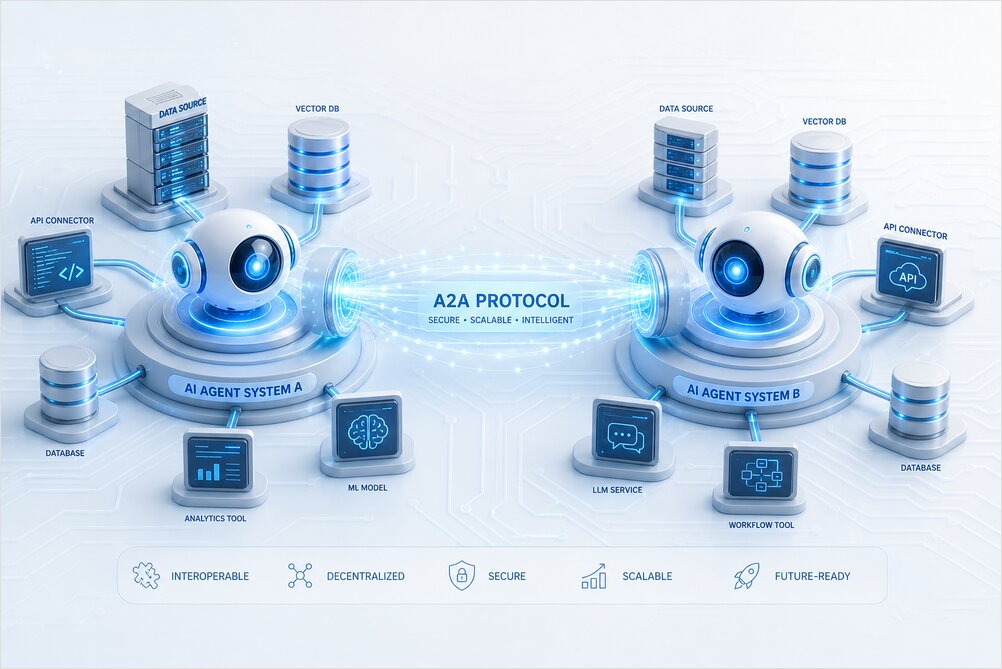
A2A is not dead, but it is also not universally useful. The practical reality is that A2A is becoming genuinely valuable in a specific context: where agents are independent systems with their own ownership, tools, and trust boundaries, rather than just internal functions or tool wrappers. That distinction between tool integration and agent delegation is what the protocol is actually designed to address, and understanding it is the key to evaluating A2A without the hype in either direction.
What Is Google’s A2A Protocol?
A2A stands for Agent2Agent Protocol, and that name captures its purpose precisely. It is an open standard for communication and interoperability between independent AI agent systems — specifically, agents that may be built using different frameworks, languages, or vendor stacks.
A2A is not mainly about connecting an agent to a database, file system, calendar, API, or search index. That is closer to the job of MCP, the Model Context Protocol. A2A is about something different: one agent communicating with another agent, treating the peer system as an actor with its own capabilities rather than a passive data source.
A typical A2A flow might involve:
- Discovering an agent through an Agent Card
- Reading the agent’s skills and capabilities
- Sending a task
- Exchanging messages
- Receiving status updates
- Handling input-required states
- Receiving final artifacts
- Tracking completion, failure, or cancellation
The important word in that list is “task.” A2A is not just a function call with a different wrapper — it is a task lifecycle protocol for agent collaboration, designed to handle the full arc from discovery and delegation through execution, status updates, and artifact return. For a deep technical walkthrough of each concept — Agent Cards, task lifecycle, messages, parts, and artifacts — see What Is the A2A Protocol? Agent Cards and Tasks Explained. For how streaming, push notifications, and human-in-the-loop pauses work in production, see A2A Streaming and Async Tasks for Long-Running Agent Workflows.
Why A2A Was Easy To Mock
A2A arrived in a market already drowning in agent acronyms.
By 2025, developers were already dealing with:
- LLM APIs
- Function calling
- Tool calling
- Agent frameworks
- MCP servers
- RAG pipelines
- Workflow engines
- Multi-agent orchestration libraries
- Custom JSON protocols
- Internal plugin systems
So when Google announced A2A, a common reaction was predictable:
“Do we really need another standard?”
The skepticism was not irrational, and it came from several directions at once. A2A looked like it overlapped with MCP. It came from Google, which made some developers worry about long-term commitment. It arrived before most teams had even solved basic tool access, prompt injection, observability, cost control, and security for single-agent systems.
In that environment, “agent-to-agent interoperability” sounded ambitious, but also a little premature.
And to be blunt, many AI agent demos in 2025 did not need A2A at all.
They needed better prompts, better tools, better permissions, better retry logic, and better logs.
The 2026 Update: A2A Is Not Dead
The big change in 2026 is that A2A is no longer only a Google announcement.
By April 2026, the Linux Foundation reported that the A2A project had passed 150 supporting organizations, gained major cloud platform integrations, and reached production deployments across multiple industries.
That does not mean every claim should be swallowed without skepticism. “Supported by” is not the same thing as “deeply used in production by most developers”. Protocol ecosystems often look larger in press releases than they feel in day-to-day engineering work.
The signal matters, however, because it is harder to dismiss. A2A has crossed an important line: it is no longer just a Google blog post. It has a formal specification, governance momentum, public examples, SDK work, cloud platform attention, and a growing ecosystem around agent interoperability. That makes the “dead” label difficult to defend on technical or adoption grounds.
A more defensible criticism is that A2A is alive but its useful scope is narrower than the hype suggests.
A2A vs MCP: The Confusion That Would Not Die
Most A2A confusion comes from its relationship with MCP.
MCP, created by Anthropic, standardizes how AI applications connect to external tools and data sources. MCP servers expose tools, resources, and prompts. AI hosts and clients consume them.
In simple terms:
- MCP connects agents to tools.
- A2A connects agents to other agents.
That sounds clean, but the real world is considerably messier. An MCP server can expose something that looks very agentic — for example, an MCP tool named research_company that internally runs search, retrieval, summarization, ranking, and report writing. From the MCP host’s point of view, it is a tool. From an architecture point of view, it is hiding an agent-like workflow behind a function call boundary. This ambiguity is precisely why some developers argued A2A was unnecessary: if an agent can be represented as an MCP tool, why create a separate protocol?
The answer is that A2A gives first-class structure to things MCP treats more awkwardly:
- Agent discovery
- Agent capabilities
- Task lifecycle
- Long-running work
- Multi-turn task state
- Agent-to-agent messaging
- Artifacts
- Collaboration between opaque agents
- Delegation across organizational boundaries
MCP can wrap a great deal, but wrapping everything as a tool eventually becomes a bad abstraction. At some point, a specialist system has enough of its own state, policy, lifecycle, and decision-making authority that modeling it as a tool obscures the architecture rather than simplifying it. That is the inflection point where treating a peer agent as a peer agent — rather than as a tool call — starts to pay off. For a detailed comparison of where the boundary falls in practice, see A2A vs MCP: Do AI Agents Really Need Both Protocols?
The Best Mental Model: MCP Below, A2A Above
The cleanest architecture is not “A2A vs MCP”.
The cleanest architecture is layered:
In this model:
- A2A is the agent collaboration layer.
- MCP is the tool integration layer.
That is the pattern that makes the most sense in 2026, and it is the framing that most serious agent architects are converging on. A2A should not replace MCP, and MCP should not be forced to represent every agent boundary — they solve different problems at different layers of the stack. The “protocol war” framing is mostly lazy analysis that makes for good headlines while doing nothing to help engineers design better systems.
Where A2A Is Actually Useful
A2A becomes useful when an agent is no longer just a library call inside your application.
It is useful when agents are:
- Independently deployed
- Owned by different teams
- Built with different frameworks
- Exposed by vendors
- Running with their own tools and permissions
- Responsible for long-running tasks
- Returning artifacts rather than simple values
- Part of a broader multi-agent workflow
For example, imagine an enterprise assistant that needs to prepare a supplier risk report.
It might delegate work to:
- A procurement agent
- A legal review agent
- A finance agent
- A compliance agent
- A market research agent
- A report writing agent
Each agent has its own domain, tools, rules, permissions, and audit requirements.
For that kind of system, A2A is not absurd. It is a reasonable boundary.
The primary assistant should not need direct access to every procurement database, legal policy store, finance spreadsheet, and compliance workflow. It should ask the responsible agent to perform the task.
That is the essential distinction: tool access is a vertical connection between an agent and its resources, while domain delegation is a horizontal handoff between autonomous agents, each with its own boundary of authority and accountability. The layered model for how these components combine — LLM, memory, tooling, routing, and observability — is covered in AI Assistant Architecture: LLM, Memory, Tools, Routing, Observability.
Where A2A Is Still Overhyped
A2A is overhyped when people present it as mandatory infrastructure for every AI project.
Most projects do not need it.
If you are building a local coding assistant, a chatbot for your docs, a small internal automation agent, or a single workflow that calls a handful of tools, A2A is probably unnecessary.
You may need:
- MCP
- Good tool schemas
- Guardrails
- Evaluation
- Logging
- Cost control
- Retry logic
- Better prompts
- Better retrieval
You probably do not need a full agent-to-agent protocol.
A2A can be a mistake when:
- There is only one agent
- All components live in one codebase
- Workflows are short and synchronous
- Agents do not need discovery
- Agents do not need independent task state
- There are no external agent providers
- An API or queue would be simpler
- The team cannot operate the extra complexity
A protocol is not free. It adds concepts, failure modes, debugging overhead, security concerns, and operational work.
In many small systems, adopting A2A is architecture cosplay — borrowing the vocabulary of distributed agent systems without any of the actual boundary problems that make the protocol valuable.
A2A And The Google Problem
Part of the A2A skepticism comes from Google itself.
Developers have long memories. When Google launches a platform, protocol, product, or ecosystem, many engineers immediately ask:
“Will this still exist in three years?”
That reaction is not entirely fair to the A2A technical design, but it is a real adoption factor.
The Linux Foundation hosting story helps here. A2A becoming part of a broader open governance environment makes it less dependent on Google’s internal priorities.
That does not guarantee success. Open governance does not magically create developer adoption. But it does reduce one of the biggest concerns: that A2A is only a Google-controlled strategic move.
In 2026, A2A should be judged less as “Google’s protocol” and more as an emerging agent interoperability standard that Google helped start.
That is a healthier lens, and it is the one that makes A2A’s technical merits easier to evaluate on their own terms rather than through the filter of Google’s historical relationship with developer ecosystems.
Adoption: Strong Signal, But Not The Whole Story
The reported 150+ supporting organizations is meaningful, but it should not be confused with universal developer adoption. “Supported by” is a spectrum, not a binary, and it helps to read adoption claims with that in mind.
At the weakest end is logo adoption: a company says it supports the standard, which may reflect genuine implementation, strategic positioning, a prototype, or simply planned support that has not materialized. Slightly stronger is SDK adoption, where developers can actually build with available libraries, examples, and documentation — this means the protocol has moved from slideware into working implementation, and real engineers have found it worth their time. Stronger still is platform adoption, where clouds, agent frameworks, and enterprise systems expose real native support, making A2A a plausible default architectural choice rather than something teams have to wire together themselves.
The only adoption tier that really matters for long-term ecosystem health is production retention. For a sense of what real adoption curves look like in the AI agent space — measured in GitHub stars, OpenRouter tokens, and download trends — the OpenClaw vs Hermes Agent popularity data shows how quickly momentum builds and plateaus once early adopter energy subsides.: teams relying on the protocol for live workflows beyond the initial 90-day honeymoon. The Linux Foundation’s 2026 update claims production use across multiple industries, which is meaningful evidence. But the more useful question is not “who supports A2A?” — it is “who keeps A2A in production after the first real operational incident?” Long-term retention under pressure is the signal that separates genuine infrastructure from protocol theater.
The Real Test: Retention In Production
Developer hype is cheap, and production retention is expensive. The two are rarely proportional, which is why the 90-day retention question matters more than launch-week enthusiasm.
A2A will prove itself if teams keep using it after they encounter:
- Authentication problems
- Authorization problems
- Agent identity problems
- Debugging issues
- Task lifecycle edge cases
- Streaming failures
- Version compatibility
- Vendor differences
- Cost surprises
- Security reviews
- Audit requirements
- Human approval workflows
This is where many agent frameworks and protocols fail. They look elegant in diagrams, then become painful in production.
A2A has a good reason to exist, but good reasons do not automatically translate into production resilience. The protocol has to survive the operational reality it encounters on the way from demo to deployment.
The best sign for A2A in 2026 is not that people are writing blog posts about it. The best sign is that enterprises are starting to use it for real multi-agent boundaries.
The worst sign would be if developers only use it in demos while production systems fall back to custom APIs and queues.
Security Is The Biggest Unresolved Question
A2A’s hardest problems are not syntax or specification problems. They are trust problems that emerge when you actually deploy autonomous agents across organizational or system boundaries.
When one agent talks to another agent, several questions become urgent:
- Who is this agent?
- Who owns it?
- What is it allowed to know?
- What is it allowed to do?
- Can it delegate work further?
- Can it call tools on behalf of a user?
- Can it preserve user intent?
- Can it prove what happened?
- Can it be audited after the task completes?
These questions are not optional in enterprise environments.
A2A makes agent collaboration easier. It also creates new places where trust can break.
For example:
- A malicious agent could misrepresent its capabilities.
- A compromised agent could request sensitive context.
- A delegated task could exceed the user’s authority.
- An agent could return poisoned artifacts.
- A chain of agents could make accountability unclear.
- Sensitive data could flow across boundaries without proper logging.
This is why serious A2A systems need more than protocol compliance.
They need:
- Strong agent identity
- Scoped authorization
- Task-level audit logs
- Delegation tracking
- Human approval for risky actions
- Artifact provenance
- Rate limits
- Policy enforcement
- Observability across agent boundaries
A2A is not a security architecture by itself — it is a communication protocol that must be deployed inside one, with explicit decisions made about identity, authorization, audit, and policy enforcement at every boundary it crosses. A2A and MCP Agent Security: Identity, Delegation, and Audit Trails lays out that surrounding architecture in detail.
A2A And The Agent Marketplace Idea
One of the more interesting long-term A2A use cases is agent marketplaces.
If agents can advertise capabilities through Agent Cards, then other agents or platforms can discover them, evaluate them, and send tasks.
That creates a possible future where agent capabilities become more modular:
- A tax agent
- A legal agent
- A code review agent
- A travel planning agent
- A security analysis agent
- A procurement agent
- A data quality agent
Each could expose a standard interface for task-based collaboration.
This sounds exciting, but it is also where hype gets dangerous.
An open agent marketplace requires more than Agent Cards. It needs identity, reputation, billing, compliance, sandboxing, liability, versioning, and dispute resolution.
Without those, an agent marketplace becomes a security incident waiting to happen.
A2A is a useful building block for this kind of future, but it is one piece of a much larger puzzle that also requires identity systems, reputation mechanisms, billing infrastructure, compliance controls, and dispute resolution before it becomes a safe market to operate in.
A2A For Internal Enterprise Agents
The more realistic near-term use case is not public agent marketplaces.
It is internal enterprise agent networks.
Large organizations already have many boundaries:
- Teams
- Departments
- Systems
- Vendors
- Data domains
- Compliance zones
- Security policies
- Approval processes
A2A maps naturally onto these boundaries, because the protocol is designed around the same fundamental need: structured communication between systems that have their own ownership and do not share a codebase. The broader AI Systems cluster covers how specialist agents like Hermes and OpenClaw fit into this kind of layered architecture in practice.
Instead of building one giant assistant with direct access to everything, an enterprise can build specialist agents with limited responsibility:
- HR agent
- Finance agent
- Support agent
- DevOps agent
- Security agent
- Knowledge management agent
- Data platform agent
Each agent can own its tools and policies internally. Other agents can interact with it through A2A.
This is a much better model than giving a single general-purpose agent direct access to every system in the organization, both from a security perspective and from an operational one. Each specialist agent can be owned, operated, audited, and secured independently, which also makes the overall system easier to reason about when something goes wrong.
A2A For Small Teams And Indie Hackers
For small teams building products with one or two agents, A2A is genuinely less urgent — and often a distraction from more immediate problems. You probably do not need an agent-to-agent protocol yet.
Use normal code. Use HTTP APIs. Use queues. Use MCP where tool integration matters.
Add A2A when you actually have:
- Multiple independent agents
- Third-party agent boundaries
- Long-running delegated tasks
- Agent discovery requirements
- Artifact exchange requirements
- Cross-framework interoperability needs
The sequence matters more than the ambition. Start with the simplest architecture that exposes the real pressure points, and let those pressure points tell you whether you actually need A2A before committing to the complexity it brings. For most small builders, MCP first and A2A later is the right path.
A Practical Decision Framework
Use this framework when deciding whether A2A belongs in your system.
No A2A when the workflow is local. Avoid A2A when everything runs inside one application and the components are not independently deployable. A Python function, class, service, queue, or workflow engine is probably enough.
MCP when the agent needs tools. Use MCP when your agent needs standardized access to files, databases, APIs, SaaS systems, search indexes, repositories, internal documentation, or observability systems. MCP gives immediate practical value and is the right starting point for most teams building agents today.
A2A when the agent needs peers. Use A2A when your agent needs to communicate with other independent agents — especially when those agents have their own capabilities, policies, state, tools, owners, deployment lifecycle, and security boundary.
Both when the architecture has layers. Use both when specialist agents collaborate with each other and each specialist also needs tools. The production pattern is A2A between agents and MCP between agents and tools. That is the most sensible version of the 2026 agent protocol stack, and the architecture that maps most cleanly onto how production multi-agent systems are actually being built.
Common Mistakes With A2A
Using A2A because it sounds strategic. This is the classic enterprise architecture trap. A2A should solve a real boundary problem that exists in the architecture, not one invented to justify the protocol choice. If there is no genuine boundary — no independent deployment, no separate ownership, no distinct security perimeter — there is probably no need for A2A.
Treating MCP and A2A as competitors. MCP is not obsolete because A2A exists, and A2A is not unnecessary because MCP exists. They address different structural problems and work best as complementary layers, not competing alternatives.
Exposing every capability as an agent. A calculator does not need to be an agent. A weather API does not need to be an agent. A database query does not need to be an agent. Many things are straightforward tools, and the agent abstraction adds overhead without adding clarity when applied to components that have no meaningful autonomy, state, or lifecycle of their own.
Hiding a full agent behind one tool. The opposite mistake is also common. If a “tool” has its own task lifecycle, memory, policies, artifacts, and delegation behavior, it might deserve to be modeled as an agent rather than squeezed behind a function call boundary.
Ignoring observability. Multi-agent systems without traces are painful to debug and impossible to audit. You need to know which agent received the task, which messages were exchanged, which tools were called, which artifacts were produced, which policies were applied, and which agent made the final decision. Without that visibility, debugging becomes archaeology — reconstructing what happened by inference rather than observation. The full observability stack for AI and LLM-backed systems, including metrics, distributed traces, and SLOs that span agent boundaries, is covered in Observability for LLM Systems: Metrics, Traces, Logs, and Testing in Production.
So Is A2A Overhyped?
Yes, partly. A2A is overhyped when it is presented as the inevitable default for all AI agent systems, when people imply that every developer needs to adopt it immediately, when agent demos use A2A to coordinate what could have been three function calls, or when the protocol discussion ignores identity, authorization, observability, and production operations. These are real examples of hype that makes A2A sound more universal than it is.
But overhyped does not mean useless. Many important technologies are overhyped before they become boring infrastructure, and the hype often arrives well before the ecosystem is mature enough to support it. The real question is not whether the marketing is excessive — it clearly is at times. The real question is whether the underlying abstraction is useful, and for A2A, the answer is yes when agents become genuinely independent actors in a system with real boundaries, real ownership, and real stakes.
So Is A2A Dead?
No.
The “A2A is dead” argument made more sense during the early skepticism phase, when the protocol looked like a Google-led response to MCP momentum.
In 2026, that argument is weaker.
A2A has a formal specification, ecosystem support, Linux Foundation momentum, major cloud attention, and reported production deployments.
None of that makes A2A dominant, mandatory, or universally loved by the developer community — but it clearly is not dead. A better statement is that A2A is alive and still proving its production value beyond enterprise and platform ecosystems, which is where most of the confirmed deployments currently live.
So Is A2A Finally Useful In 2026?
Yes, but only in the right architecture. A2A is useful when your system has real agent boundaries — not just because your code has multiple prompts, or because your system uses the word “agent” in variable names. It becomes useful when agent collaboration genuinely needs standard structure:
- Discovery
- Capabilities
- Task lifecycle
- Messages
- Artifacts
- Long-running work
- Opaque implementation boundaries
- Cross-vendor interoperability
That is where A2A earns its place, by providing a common contract for collaboration that would otherwise require custom protocol work at every boundary.
My Opinionated Take
A2A is not the protocol most developers should start with — MCP is. MCP solves a more immediate and broadly applicable problem: connecting agents to useful tools and context. A2A solves a later-stage problem: connecting independent agents to each other across real deployment and ownership boundaries. That makes MCP more useful today for the vast majority of individual developers and small teams.
A2A may become more important as agent systems mature from demos into enterprise workflows. Once organizations have multiple specialist agents owned by different teams, the need for a standard agent-to-agent boundary becomes obvious and the overhead of the protocol starts to pay for itself.
My practical recommendation is to start with MCP, design clean agent boundaries from the beginning, and add A2A only when those boundaries become real deployment, ownership, or interoperability constraints. Do not adopt A2A for vibes. Adopt it when the architecture demands it.
Final Verdict
Google’s A2A protocol is not dead.
It is also not the universal future of every AI agent project.
It is a useful, still-maturing protocol for a specific problem: communication between independent AI agents.
If you are building a simple assistant, A2A is probably unnecessary.
If you are building a multi-agent enterprise system, an agent marketplace, a vendor-neutral agent network, or a set of independently deployed specialist agents, A2A is worth serious attention.
The best 2026 framing is not:
A2A vs MCP
It is:
MCP for tools.
A2A for agents.
Both for serious multi-agent systems.
That is less dramatic than a protocol war narrative, but it is also more accurate and more useful to engineers who need to make real architectural decisions.
Sources
- https://developers.googleblog.com/en/a2a-a-new-era-of-agent-interoperability/
- https://a2a-protocol.org/latest/specification/
- https://a2a-protocol.org/latest/topics/a2a-and-mcp/
- https://github.com/a2aproject/A2A
- https://www.linuxfoundation.org/press/a2a-protocol-surpasses-150-organizations-lands-in-major-cloud-platforms-and-sees-enterprise-production-use-in-first-year
- https://modelcontextprotocol.io/specification/2025-06-18
- https://www.anthropic.com/news/model-context-protocol
- https://www.linuxfoundation.org/press/linux-foundation-announces-the-formation-of-the-agentic-ai-foundation
